
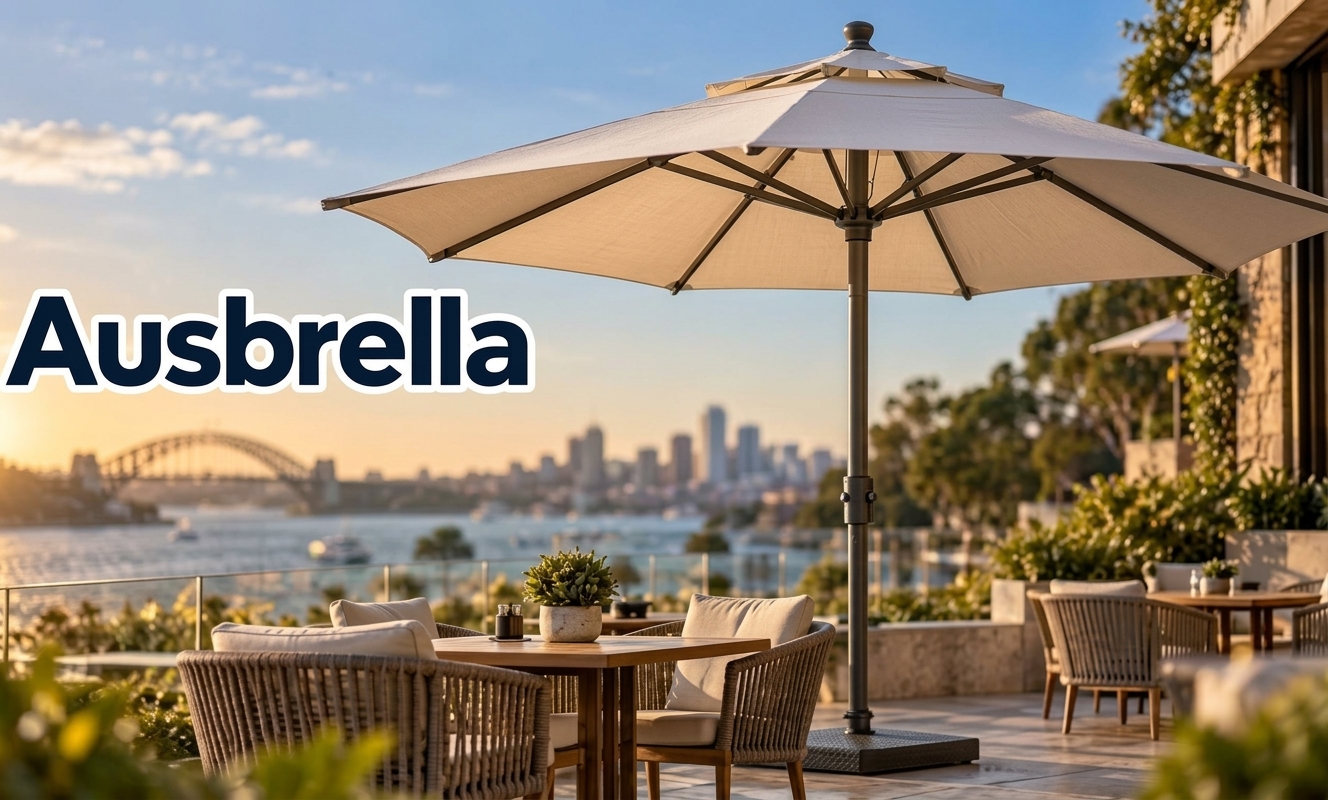
Ausbrella is a premium range of large outdoor market umbrellas developed for locations that need reliable shade and a reinforced structure. The range is manufactured by Awnet, an Australian company that produces commercial umbrellas and café barriers.
Unlike a typical lightweight garden umbrella, an Ausbrella model uses a specially designed aluminium pole, a securely attached canopy, and an opening system that does not rely on conventional ropes and pulleys.
These features make the range relevant to several settings:
- Restaurants and outdoor cafés
- Hotels and resorts
- Swimming pools and leisure areas
- Public spaces managed by councils
- Clubs, hospitality venues, and outdoor bars
- Residential patios and entertaining areas
The main attraction is its focus on strength and long-term outdoor use. However, the right choice depends on the location, wind exposure, mounting arrangement, and specific model.
2. Who Makes Ausbrella?
Awnet, a division of Asigns Pty Ltd, designs and manufactures Ausbrella in Australia. The company operates from Dandenong, Melbourne, Victoria, and has experience producing commercial market umbrellas and outdoor café barriers.
Awnet identifies founder Chris Pierias as the person behind the Ausbrella concept. The design addresses a familiar challenge: creating a large shade umbrella that can offer greater structural strength without relying on an unnecessarily heavy centre pole.
The manufacturer’s official website provides information about the product range, construction, wind testing, and warranty.
You can review the details directly on the official Ausbrella product page.
3. How Does Ausbrella Work?
The design focuses on reinforcing the umbrella’s central structure and securing the canopy. These elements help the umbrella withstand the forces that affect large outdoor shade products.
Twin-skin aluminium pole
The standard Ausbrella design uses a twin-skin aluminium centre pole. This construction aims to combine structural strength with manageable weight.
The Hurricane model uses a double twin-skin pole arrangement, which Awnet presents as an additional reinforcement for demanding wind conditions.
Secure canopy attachment
Instead of relying on a loose, conventional canopy arrangement, Ausbrella uses a bolted-on fabric cover. This design helps secure the canopy to the structure.
Rope-free opening mechanism
The opening system avoids traditional ropes and pulleys. This can simplify operation and reduce dependence on those conventional components.
Engineered construction
Awnet states that its umbrellas are engineered and certified. Buyers should request the relevant documentation for the exact model and installation being considered.
4. Key Features and Benefits of Ausbrella
The product range combines structural design, outdoor shade, and commercial usability. Its practical benefits depend on the installation and the environment.
Wind-focused engineering
Wind resistance is one of the range’s main selling points. The Storm 135 and Hurricane 160+ have different published wind-performance claims, allowing buyers to compare models against their site’s requirements.
Australian manufacturing
Local manufacturing can make communication, customisation, and warranty discussions more straightforward for Australian buyers.
Commercial appearance
Large market umbrellas provide shade while helping define outdoor dining areas, poolside seating, and hospitality spaces.
Repair and long-term use
Awnet promotes durable, repairable products. For a business with several umbrellas, repair options may reduce the need to replace complete units when individual components wear out.
Custom branding
Awnet offers custom branding across its broader commercial umbrella range. Ask the manufacturer which branding, canopy, and configuration options are available for the specific Ausbrella model.
5. Ausbrella Storm 135 vs. Hurricane 160+
The two main models serve different levels of wind exposure. The Storm 135 is designed for demanding general outdoor use, while the Hurricane 160+ targets locations that need a higher stated wind-performance level.
Ausbrella Storm 135
The Storm 135 has a published wind rating of 135 km/h on its dedicated product page. Awnet also describes testing in the Monash University wind tunnel at that speed.
Its key features include:
- Twin-skin aluminium centre pole
- Eight radial arms, according to the manufacturer
- Bolted-on canopy
- Rope-free opening system
- Matching in-ground stainless-steel socket
- Five-year warranty on the frame and acrylic canvas cover
This model may suit hospitality areas, residential outdoor spaces, and commercial locations where its specifications match the site requirements.
Ausbrella Hurricane 160+
The Hurricane 160+ is the more wind-focused model. Awnet reports wind-tunnel testing beyond 160 km/h, with the test reaching approximately 161 km/h.
Its double twin-skin pole arrangement distinguishes it from the Storm design. It also features engineered construction, a secured canopy, and a rope-free opening mechanism.
The Hurricane may be worth investigating for exposed commercial sites, but buyers should confirm the approved configuration, foundation, installation method, and engineering documentation before selecting it.
Important: A wind-tunnel result does not mean an umbrella can safely remain open in every storm. Real-world wind conditions, turbulence, ground fixings, terrain, and installation quality all affect performance.
6. Complete Ausbrella Specifications Table
The following table summarises the information published by Awnet. It separates model-specific specifications from details that require confirmation.
| Specification | Storm 135 | Hurricane 160+ |
|---|---|---|
| Product type | Heavy-duty folding market umbrella | Heavy-duty folding market umbrella |
| Manufacturer | Awnet | Awnet |
| Country of manufacture | Australia, according to Awnet | Australia, according to Awnet |
| Main structural design | Twin-skin aluminium pole | Double twin-skin pole |
| Published wind-performance figure | 135 km/h on dedicated product page | Tested beyond 160 km/h, according to Awnet |
| Wind-test information | Manufacturer reports a 135 km/h Monash University wind-tunnel test | Manufacturer reports testing beyond 160 km/h |
| Canopy attachment | Bolted-on fabric cover | Bolted-on fabric cover, according to the range specifications |
| Opening system | No conventional ropes or pulleys | No conventional ropes or pulleys |
| Mounting option | Matching in-ground stainless-steel socket | Matching in-ground stainless-steel socket |
| Engineering information | Manufacturer says engineering certification is available | Manufacturer says engineering certification is available |
| Warranty | Five years on frame and acrylic canvas cover | Confirm the applicable written warranty for the quoted configuration |
| Best potential use | Sites suited to the Storm’s specified performance | Sites requiring the higher stated wind-performance level |
| Public fixed price | Not clearly listed | Not clearly listed |
| Purchase route | Contact Awnet for a quotation | Contact Awnet for a quotation |
Specifications are based on Awnet’s published product information. Confirm the latest technical documents, warranty conditions, dimensions, and installation requirements before purchasing.
7. Understanding Ausbrella Wind Ratings
Wind ratings are important when choosing a commercial or residential shade umbrella, but they need careful interpretation.
A rating describes a stated performance level under specified conditions. It does not automatically guarantee that the umbrella will remain safe in every environment at that wind speed.
For example, Awnet lists the Storm 135 with a 135 km/h rating and reports Hurricane 160+ testing beyond 160 km/h. These figures help distinguish the models, but they are not a substitute for reviewing the complete engineering documentation.
Before buying, ask these questions:
- What test conditions produced the published wind rating?
- Was the umbrella tested open, closed, or in a particular configuration?
- What foundation or mounting system did the test use?
- Does the certification cover your proposed installation?
- What wind conditions require closing the umbrella?
- Are there local building, safety, or council requirements?
The answers help you assess whether the product suits your site instead of relying on a headline number alone.
8. Is Ausbrella Suitable for Commercial Use?
Ausbrella is designed with commercial outdoor environments in mind. Restaurants, hotels, resorts, clubs, and public facilities may benefit from its reinforced construction and large shaded areas.
For a restaurant, outdoor shade can make seating more comfortable and help organise dining zones. Resorts and hotels may use market umbrellas around pools, terraces, and outdoor lounges.
Councils and venue operators may also value a product that can be maintained instead of discarded whenever a component wears out.
However, commercial buyers should assess the total installation, not only the umbrella itself. Important considerations include:
- The number and size of umbrellas required
- Expected daily use
- Wind exposure and surrounding structures
- Safe anchoring and access
- Cleaning and maintenance needs
- Replacement-part availability
- Warranty coverage and service response
For larger projects, request a written quotation and a site-specific recommendation.
9. Can You Use Ausbrella at Home?
Yes. A suitable Ausbrella configuration may work in a residential patio, garden entertaining area, poolside space, or outdoor kitchen.
The main advantage is the opportunity to install a shade umbrella designed for more demanding conditions than many basic patio products. Its premium construction may appeal to homeowners who prefer to invest in a long-term outdoor feature.
Still, a residential installation requires careful planning.
Measure the area, check the canopy’s clearance, consider nearby windows and fences, and determine whether an in-ground socket is practical. You should also ask about any alternative mounting arrangements available for the chosen model.
A heavy-duty umbrella may not be the best choice for a small balcony or a location where permanent ground fixing is impossible. Match the product to the space rather than buying solely for its headline wind rating.
10. Materials, Durability, and Weather Protection
Outdoor umbrellas face sunlight, rain, wind, airborne dirt, and repeated opening and closing. Materials and construction therefore influence maintenance needs and service life.
Aluminium structure
The aluminium pole forms a key part of the Ausbrella design. Its twin-skin construction is intended to provide strength without depending on a solid, oversized pole.
Acrylic canvas
Awnet identifies acrylic canvas as the canopy material covered by the Storm 135’s five-year warranty. Buyers should confirm the precise fabric specification and coverage for their selected model.
Stainless-steel socket
The matching in-ground socket provides a mounting point for the umbrella. Correct installation matters because even a well-engineered umbrella can be unsafe if its foundation does not suit the site.
Practical durability considerations
To support a longer service life:
- Inspect the frame, canopy, and fasteners regularly.
- Remove dirt and debris using the manufacturer’s recommended cleaning method.
- Allow wet fabric to dry appropriately before storage when the design permits.
- Check the mounting system for movement or corrosion.
- Follow the manufacturer’s instructions for wind and storm conditions.
- Arrange repairs when parts show damage or excessive wear.
No outdoor material is maintenance-free. Regular inspections can help identify issues before they become more expensive.
11. Ausbrella Warranty and Maintenance
Awnet advertises a five-year warranty on the Storm 135 frame and acrylic canvas cover. Warranty conditions can vary by model, component, installation, and the circumstances of a claim.
Do not assume that every part, type of damage, or wind event receives identical coverage. Ask for the complete written warranty before placing an order.
Confirm these points with the supplier:
- Which components are covered?
- When does the warranty period begin?
- Are labour, transport, and installation included?
- What maintenance does the warranty require?
- What exclusions apply to wind, storms, misuse, or improper installation?
- How can replacement parts or repairs be arranged?
A clear warranty helps you calculate the product’s long-term value more accurately.
12. How Much Does Ausbrella Cost?
Awnet does not clearly publish one fixed retail price for the entire Ausbrella range on its main product pages. The final quotation may depend on the model, canopy configuration, branding, mounting arrangement, and project requirements.
Instead of estimating an unsupported price, request a current quote from the manufacturer through the official Awnet website.
When comparing quotes, review the complete package rather than just the umbrella price. Include any required socket, foundation work, delivery, installation, custom branding, and ongoing maintenance.
A cheaper product may cost more over time if it needs frequent replacement. Conversely, a premium umbrella is not automatically the best investment if its capabilities exceed your site’s needs.
Compare the expected service life, warranty, repair options, and installation costs before making a decision.
13. Advantages and Limitations of Ausbrella
A balanced assessment should consider the product’s strengths as well as the practical factors that may make it unsuitable for certain buyers.
| Advantages | Limitations or checks |
|---|---|
| Designed for demanding outdoor conditions | Premium pricing needs to be confirmed by quotation |
| Reinforced aluminium pole construction | Correct mounting is essential |
| Published wind-performance information | Test ratings do not guarantee safety in all storms |
| Rope-free opening system | Buyers should test operation and maintenance needs |
| Australian manufacturing | Availability and delivery times should be confirmed |
| Five-year Storm 135 frame and canopy warranty advertised | Warranty exclusions must be reviewed |
| Repairability promoted by the manufacturer | Parts and repair costs should be checked |
| Suitable for commercial and selected residential settings | May be excessive for small, sheltered spaces |
The main benefit is its focus on structural performance. The main purchasing challenge is ensuring the model, installation, and cost match the actual site.
14. How to Choose the Right Ausbrella
Use this checklist before requesting a quotation.
Step 1: Assess your location
Identify whether the umbrella will sit in a sheltered garden, an exposed restaurant terrace, a pool area, or a public space. Record surrounding buildings, terrain, and likely wind exposure.
Step 2: Compare the models
Review Storm 135 and Hurricane 160+ specifications. Choose based on the site’s needs and verified engineering guidance, not the largest number alone.
Step 3: Confirm the installation
Ask which socket or foundation is suitable. Have a qualified professional assess the mounting requirements where necessary.
Step 4: Check the canopy and dimensions
Confirm the required shade area, canopy fabric, colours, clearance, and any branding options.
Step 5: Review total cost
Include delivery, mounting, installation, maintenance, and potential repairs in your budget.
Step 6: Get written documentation
Request current specifications, engineering documents, wind-test information, and the complete warranty.
This process helps you make a more confident decision and reduces the risk of buying an umbrella that does not suit the site.
15. Frequently Asked Questions About Ausbrella
1. What is Ausbrella?
Ausbrella is an Australian-made range of premium outdoor market umbrellas manufactured by Awnet. The range focuses on reinforced construction, engineered components, and outdoor shade for commercial and residential settings.
2. Who manufactures Ausbrella umbrellas?
Awnet manufactures the range in Australia and operates as a division of Asigns Pty Ltd. The company is based in Dandenong, Melbourne, Victoria.
3. How strong is Ausbrella in high winds?
Awnet publishes a 135 km/h wind rating for the Storm 135 and reports Hurricane 160+ wind-tunnel testing beyond 160 km/h. These figures relate to the manufacturer’s stated testing and do not guarantee safety under every real-world condition.
4. What is the difference between Storm 135 and Hurricane 160+?
Storm 135 uses a twin-skin aluminium pole and has a published 135 km/h rating. Hurricane 160+ uses a double twin-skin pole and has a higher reported wind-test level, making it the more wind-focused model.
5. Does Ausbrella come with a warranty?
Awnet advertises a five-year warranty covering the Storm 135 frame and acrylic canvas cover. Confirm the exact terms, exclusions, and applicable warranty for any other model before buying.
6. How can I buy Ausbrella, and how much does it cost?
Contact Awnet through its official website to request current pricing and availability. The quotation may depend on the model, configuration, mounting requirements, and custom options.
16. Final Verdict: Is Ausbrella Worth Considering?
Ausbrella stands out as a specialised outdoor umbrella range for buyers who place a high priority on structural design, wind-performance information, and long-term commercial use. Its Storm 135 and Hurricane 160+ models provide different stated performance levels, while features such as twin-skin aluminium poles, secured canopies, and rope-free opening systems distinguish the range from basic patio umbrellas.
The best choice depends on more than the advertised wind rating. Review the engineering documents, confirm the mounting requirements, compare the written warranty, and request a complete quotation before committing to a purchase.
If you manage a restaurant, resort, public outdoor area, or premium residential patio, start by assessing your site and asking Awnet which configuration fits it. A well-matched umbrella can provide useful shade and support a more practical outdoor space for years to come.