
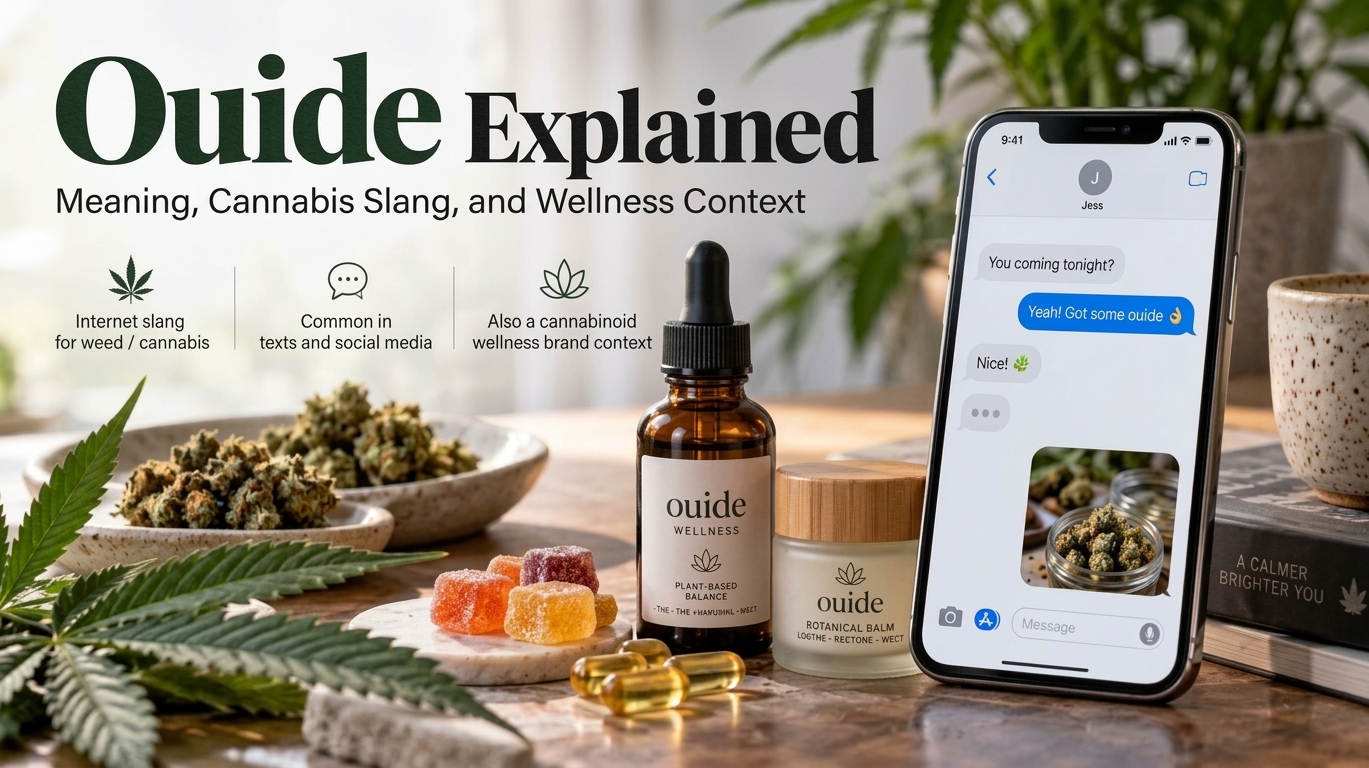
Ouide is a Canadian cannabinoid brand that offers products made with compounds derived from cannabis. Its website features several product categories, including cannabinoid oils, edible products, topical formulations, and beauty-related items.
The brand presents its products around different formulations and cannabinoid combinations. These differences matter because products can contain varying amounts of cannabidiol (CBD), tetrahydrocannabinol (THC), cannabigerol (CBG), and other ingredients.
Rather than treating every product as interchangeable, consumers should examine the label and understand what each formulation contains.
The official OUIDE Wellness website provides product listings, ingredient information, and brand details. Product availability and formulations may change, so the current label should take priority over older descriptions or third-party listings.
2. Who Owns and Makes OUIDE Products?
OUIDE’s official FAQ states that its products are made at a facility in British Columbia’s Okanagan region in Canada. The company’s website also provides product-specific information and customer guidance.
For buyers researching the brand, the manufacturer’s own website is the most direct starting point for verifying product names, listed ingredients, and current availability.
However, a brand’s website is not independent proof that a product treats a medical condition or delivers a particular health outcome. Product descriptions explain how the company presents its offerings; scientific research and regulatory guidance help readers assess broader health claims.
Before making a decision, check the following:
- The company’s current product and ingredient information
- The exact cannabinoid content per serving
- The product’s intended route of use
- Applicable Canadian licensing and labelling requirements
- Any independent testing or certificate of analysis available for the specific product
These checks provide a more reliable basis for evaluating OUIDE than marketing language alone.
3. What Products Does OUIDE Offer?
The OUIDE website has featured several types of cannabinoid products. Names, formulations, and stock can change, so the following categories should be treated as a guide to the range rather than a guarantee of current availability.
Cannabinoid oils
Oil formulations contain cannabinoids in a carrier oil. Depending on the product, they may include CBD, CBG, THC, or a combination of these compounds.
Check the concentration per millilitre and the amount delivered by the stated serving. A bottle’s total cannabinoid content is not the same as the amount in one serving.
Edibles
Edibles may include gummies, tablets, chocolates, or other food-style formulations. These products can contain THC, CBD, or a combination, depending on the specific product.
Oral cannabis products can take longer to produce noticeable effects than inhaled products. That delay increases the risk of consuming more before the initial amount has taken effect. Health Canada explains this concern in its consumer information on cannabis.
Topical products
Topical formulations are applied to the skin. The category can include oils, balms, and roll-on products.
Consumers should check the ingredient list for carrier oils, fragrances, essential oils, and other substances that may irritate sensitive skin. A topical product’s presence in a wellness range does not establish that it can treat an injury or medical condition.
Beauty and personal-care products
OUIDE has also listed beauty-related items, including face oil and other topical formulations. These products should be evaluated according to their complete ingredient lists and intended cosmetic use.
4. Understanding CBD, THC, and CBG
Understanding the main cannabinoids makes it easier to compare products without relying on broad wellness claims.
| Cannabinoid | Full name | Key distinction | What to check |
|---|---|---|---|
| CBD | Cannabidiol | Does not produce the typical intoxicating high associated with THC, but can still affect the body | Amount per serving, other ingredients, potential interactions |
| THC | Tetrahydrocannabinol | The principal intoxicating cannabinoid commonly associated with a cannabis high | Strength, serving size, warnings, impairment risks |
| CBG | Cannabigerol | A different cannabinoid that researchers continue to study | Amount present, evidence for the intended use, product testing |
| Other cannabinoids | Varies | Effects and evidence differ by compound | Full formulation and current scientific evidence |
These compounds are not interchangeable. A product containing mostly CBD has a different profile from one containing a substantial amount of THC.
Health Canada notes that cannabis products can contain different combinations of cannabinoids and that higher cannabinoid amounts may increase the risk of certain adverse effects. See its guidance on choosing cannabis products.
5. How OUIDE Product Categories Differ
The main differences between OUIDE product categories involve their formulation, route of use, cannabinoid composition, and intended application.
| Product category | Typical form | Main information to check | Important consideration |
|---|---|---|---|
| Oils | Liquid formulation | Cannabinoids per millilitre and serving | Confirm how the product is intended to be used |
| Gummies and other edibles | Solid or chewable product | THC and CBD per unit and package | Effects can be delayed and long-lasting |
| Tablets or capsules | Measured solid dose | Amount of each cannabinoid per unit | Do not assume different products have equal strength |
| Topical oils | Skin-applied formulation | Ingredients and intended application | Skin irritation is possible |
| Roll-on products | Liquid with applicator | Cannabinoid content and other ingredients | Avoid use contrary to the product label |
| Beauty products | Oil or cosmetic formulation | Complete cosmetic ingredient list | Do not assume a cosmetic product has proven medical benefits |
This comparison is useful because the format alone does not tell you how strong a product is. Two oils can have very different cannabinoid concentrations, and two edible products can contain substantially different amounts of THC.
6. Complete OUIDE Product Comparison Table
The table below summarises examples of products or product lines that have appeared on the OUIDE website. It is not a substitute for current packaging or a verified, up-to-date catalogue.
| Example product or line | Product type | Published product information | What readers should verify |
|---|---|---|---|
| UPLIFT+ Gummies | Edible tablets | The website has listed a formulation with an 8:1 THC-to-CBD ratio and 25 mg total cannabinoids per tablet | Current formulation, THC amount per unit, legal availability |
| RELAX products | Edibles or capsules | The brand has listed THC-dominant formulations | Exact cannabinoid quantities and serving information |
| RECOVERY Mending Oil | Oil formulation | A product page has described a blend containing CBD, CBG, and THC | Current ingredients, concentration, intended use |
| RELIEF CBD Roll-On | Topical roll-on | A product page has listed a CBD/CBG formulation | Current cannabinoid content and skin-use instructions |
| ILLUMINE Face Oil | Beauty product | The brand has listed a face oil containing CBD/CBG | Full ingredient list and cosmetic-use directions |
| Other topical products | Topical formulations | The range has included skin-applied wellness products | Ingredients, warnings, product status, and applicable regulations |
Sources: OUIDE’s official product catalogue, FAQ, and individual product listings. Online descriptions can become outdated. Confirm every specification against the current product label before publication or purchase.
7. Understanding Cannabinoid Ratios and Potency
A cannabinoid ratio describes the relative amounts of two or more cannabinoids in a formulation. It does not automatically tell you how strong an entire product is.
For example, a product described as having an 8:1 THC-to-CBD ratio contains eight parts THC for every one part CBD, based on the quantities used to calculate that ratio. The total amount still matters.
Consider two hypothetical products:
- Product A contains 8 mg THC and 1 mg CBD per serving.
- Product B contains 24 mg THC and 3 mg CBD per serving.
Both have an 8:1 ratio, but Product B contains three times as much of each cannabinoid per serving.
When reviewing OUIDE labels, distinguish between:
- Ratio: The relative amount of one cannabinoid compared with another.
- Concentration: The amount present in a particular volume or weight.
- Serving amount: The quantity of each cannabinoid in the intended serving.
- Package total: The combined amount in the complete container.
This distinction helps prevent misunderstandings when comparing products with similar names or ratios.
8. What Ingredients Should Consumers Check?
Cannabinoids are only one part of a product’s formulation. Carrier oils, sweeteners, flavourings, preservatives, and topical ingredients may also affect suitability.
For oils, check the carrier oil and any listed flavourings. For edibles, examine sweeteners, allergens, and other ingredients. For topical products, review fragrances, essential oils, and ingredients that may irritate the skin.
Use this checklist:
- Read the complete ingredient list.
- Confirm the amount of each cannabinoid.
- Check serving size and directions.
- Review allergy and sensitivity warnings.
- Look for storage and expiry instructions.
- Ask a pharmacist or healthcare professional about potential medication interactions.
- Look for credible, product-specific testing information when available.
A clear ingredient list makes it easier to compare products and identify potential concerns. It does not, by itself, prove that a formulation is effective for a particular health condition.
9. How to Read Product Labels
A product label should provide more useful information than a brand name or a broad statement about wellness.
When reviewing an OUIDE product, look for the following details:
Total cannabinoids: Identify the amount of CBD, THC, CBG, or other listed cannabinoids in the full package.
Amount per serving: Check how much each intended serving contains. This is particularly important for edible products.
Product directions: Confirm whether the product is designed to be swallowed, held under the tongue, or applied to the skin. Do not assume all oils are used in the same way.
Warnings: Read information about impairment, interactions, storage, and who should avoid the product.
Lot and expiry information: Where provided, these details can help identify the product and determine whether it remains within its stated shelf life.
Health Canada’s guide to reading cannabis product labels explains how consumers can find key information about cannabinoid content and warnings.
10. What Does the Research Say About Cannabinoid Products?
Cannabinoid research covers several different compounds, formulations, and medical uses. Evidence about one cannabinoid or one specific medicine cannot automatically be applied to every product sold in a wellness category.
CBD does not produce the typical intoxicating high associated with THC, but it can still have effects on the body and may interact with medications. THC can impair attention, coordination, judgment, and reaction time.
Research into CBG and many multi-cannabinoid formulations remains developing. A product containing a compound of scientific interest is not necessarily proven to deliver a specific benefit.
Health Canada states that evidence remains limited for several commonly promoted uses of non-prescription CBD products. For that reason, avoid treating statements about sleep, discomfort, mood, inflammation, or recovery as established outcomes unless reliable evidence supports the specific claim.
If you are considering cannabinoids for a health concern, discuss the options with a qualified healthcare professional rather than using a brand description as medical advice.
11. OUIDE and Canadian Cannabis Regulations
Cannabis laws affect how products can be manufactured, labelled, marketed, sold, and used. A brand’s Canadian identity does not, by itself, establish that every product is available legally in every province, territory, or country.
Canadian consumers should verify the legal status of the particular product and the seller. Rules can differ according to product type, THC content, age requirements, provincial or territorial systems, and intended use.
For people outside Canada, local laws may be substantially different. A product listed on a Canadian website may not be lawful to import or possess in another country.
Before relying on a product listing, verify:
- Whether the product is legally available where you live
- Whether the seller is authorised under the applicable rules
- Which age restrictions apply
- Whether the product can legally be shipped to your location
- Whether local rules restrict possession, use, or importation
Official government guidance is more reliable than social media posts or informal reseller descriptions for answering legal questions.
12. Cannabis Edible Safety
Edible cannabis products require particular care because their effects may take time to appear. Health Canada states that effects from eating or drinking cannabis can begin within 30 minutes to two hours, and it may take up to four hours to feel the full effects.
This delay can cause a person to consume more before the first amount has taken effect. The resulting effects can be stronger or last longer than expected.
For safer handling:
- Read the label and understand the amount of THC per unit.
- Never assume a gummy or chocolate is an ordinary food.
- Keep all cannabis products locked away from children and pets.
- Do not drive or operate machinery while impaired.
- Avoid combining cannabis with alcohol or other intoxicating substances.
- Seek professional advice if you take medication or have a health condition.
- Do not use cannabis during pregnancy or breastfeeding.
If someone experiences severe or unexpected effects, seek appropriate medical assistance. Product-specific guidance and local emergency services should take priority over online advice.
13. Storage and Product Quality
Correct storage helps preserve product quality and reduces the risk of accidental exposure.
OUIDE’s FAQ advises storing edibles in a cool, dark place and refrigerating them after opening where directed. Always follow the storage instructions on the specific product because requirements can differ by formulation.
Good storage practices include:
- Keep products in their original, clearly labelled packaging.
- Follow the stated temperature and light requirements.
- Close containers securely after use.
- Keep products inaccessible to children and pets.
- Observe expiry dates and any after-opening instructions.
- Do not use products that appear damaged, contaminated, or incorrectly labelled.
Product quality also depends on manufacturing controls and appropriate testing. Where available, review a product-specific certificate of analysis and check that its batch details match the item you have.
14. How to Evaluate an OUIDE Product
A useful evaluation considers safety, ingredients, evidence, and legal availability rather than relying on product names alone.
Step 1: Define what information you need
Identify whether you are researching an oil, edible, topical, or cosmetic product. Each category has different ingredients, routes of use, and safety considerations.
Step 2: Confirm the formulation
Review the current label for CBD, THC, CBG, and other ingredients. Do not assume a product has the same formulation as an older version.
Step 3: Compare the amounts
Check the amount per serving and per package. Ratios alone do not tell you the full strength.
Step 4: Evaluate the claims
Separate the company’s description from evidence supporting a medical or wellness claim. Be cautious of claims that promise to cure, prevent, or treat a condition without reliable support.
Step 5: Check safety and legal status
Review warnings, storage instructions, local cannabis laws, and potential interactions. Consult a healthcare professional when a medical question is involved.
Step 6: Verify current information
Use the official OUIDE website for the brand’s current product details and government resources for independent safety and regulatory guidance.
This method provides a clearer basis for comparison and reduces the chance of confusing marketing language with established facts.
15. Frequently Asked Questions About OUIDE
1. What is OUIDE Wellness?
OUIDE Wellness is a Canadian cannabinoid brand with product categories that have included oils, edibles, topical formulations, and beauty-related items. Its current website is the best source for checking which products remain available.
2. Where are OUIDE products made?
According to the brand’s official FAQ, its products are made at a facility in British Columbia’s Okanagan region. Consumers should consult current company information for the latest manufacturing and product details.
3. Does OUIDE offer CBD and THC products?
The brand has listed products containing CBD, THC, CBG, and combinations of these cannabinoids. The exact contents vary by product, so read the current label rather than assuming every item has the same formulation.
4. Are OUIDE products proven to treat medical conditions?
A product listing does not establish that a product can treat a disease or symptom. Evidence varies by cannabinoid and intended use, and consumers should discuss medical questions with a qualified healthcare professional.
5. How can I check the strength of an OUIDE product?
Read the label for the amount of each cannabinoid per serving and per package. A ratio describes the relative amounts of cannabinoids but does not independently show the product’s total strength.
6. Are OUIDE products legal everywhere?
No. Legal status depends on the product, its ingredients, local laws, and the rules governing sale, possession, and importation. Verify the requirements in your location before relying on a listing or attempting to obtain a product.
16. Final Verdict: What Should You Know About OUIDE?
OUIDE Wellness is a Canadian brand with a range of cannabinoid-related products, including edible, oil, topical, and beauty formulations. Its product categories differ in ingredients, cannabinoid content, and intended use, making label checks essential.
The most useful approach is to verify current product information directly with the company, assess ingredient and potency details carefully, and use independent government guidance to understand cannabis safety and legal requirements. Do not assume that a wellness claim is medically proven simply because it appears in a product description.
For readers researching the brand, start with the official product information, compare the actual amounts of CBD, THC, and CBG, and consult a qualified professional when health questions arise. Clear information and careful evaluation are more valuable than broad promises about results.