

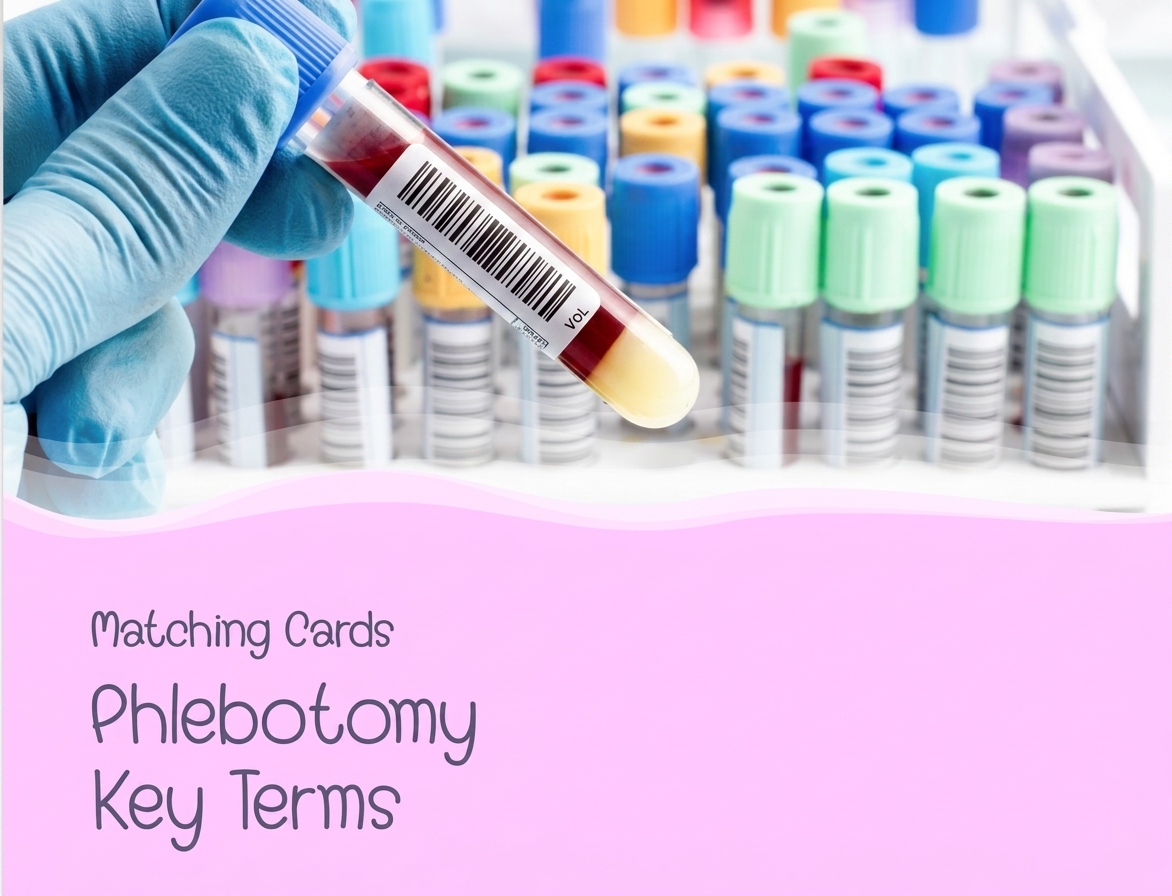
Matching 11-1 key terms and descriptions refers to a structured educational exercise in which students connect specialized terms with their most appropriate definitions or descriptions.
The version associated with Unit IV: Special Procedures in a phlebotomy workbook presents terminology related to blood collection, special testing, specimen handling, and laboratory procedures. The published sample includes terms such as AABB, ACT, aerobic, anaerobic, ARD, autologous, BAC, bacteremia, BNP, chain of custody, compatibility, CRP, EQC, ETOH, FAN, FUO, GTT, and HCG.
The goal is not simply to recognize an abbreviation. You need to understand what the term means and how it applies to laboratory or clinical practice.
That distinction makes these exercises valuable for students preparing for phlebotomy examinations and laboratory coursework.
What Does the 11-1 Format Mean?
The label can look confusing when you first see it.
In this context, matching 11-1 key terms and descriptions is the name of a particular matching exercise rather than a medical diagnosis, laboratory test, or clinical procedure.
A matching activity normally gives you:
- A list of specialized terms.
- A separate group of descriptions.
- Instructions explaining how often choices may be used.
- A requirement to identify the best relationship between each term and description.
The exercise tests recognition and understanding at the same time.
For example, if you see an abbreviation associated with blood alcohol measurement, you should connect it with the concept of alcohol concentration rather than choosing a description simply because it contains a familiar medical word.
Why This Phlebotomy Exercise Matters
Matching 11-1 key terms and descriptions is useful because phlebotomy depends heavily on precise terminology.
A phlebotomist works with:
- Patient identification.
- Blood specimens.
- Laboratory testing.
- Collection requirements.
- Quality control.
- Blood-bank terminology.
- Special testing procedures.
- Specimen documentation.
- Safety procedures.
A small misunderstanding can cause a student to confuse two completely different concepts.
The exercise therefore works as more than a vocabulary quiz. It encourages students to build connections between abbreviations, procedures, laboratory concepts, and clinical terminology.
Key Terms Covered in the Exercise
The source material includes a broad collection of laboratory and blood-collection terms.
Here are the major concepts students should understand before attempting the exercise:
- AABB: An organization associated with standards, accreditation, and education in transfusion medicine and biotherapies.
- ACT: Activated clotting time, a test used to evaluate clotting time in specific clinical settings.
- Aerobic: Describes an environment or organism associated with oxygen.
- Anaerobic: Describes an environment or organism that does not depend on oxygen in the same way aerobic organisms do.
- ARD: Antimicrobial removal device.
- Autologous: Refers to using a person’s own blood or biological material.
- BAC: Blood alcohol concentration.
- Bacteremia: The presence of bacteria in the bloodstream.
- BNP: B-type natriuretic peptide, a biomarker associated with cardiac function and heart failure assessment.
- Chain of custody: Documented control and handling of a specimen, especially when legal or forensic integrity matters.
- Compatibility: The ability of materials, samples, or blood products to be used together without an incompatible reaction.
- CRP: C-reactive protein, an inflammatory marker.
- EQC: Electronic quality-control checking performed by an instrument or testing system.
- ETOH: A common abbreviation for ethanol.
- FAN: Fastidious antimicrobial neutralization.
- FUO: Fever of unknown origin.
- GTT: Glucose tolerance testing.
- HCG: Human chorionic gonadotropin, a hormone commonly associated with pregnancy testing.
These explanations are intentionally simplified for study purposes. Students should always follow their course materials and laboratory protocols for clinical application.
Complete Key Terms and Meaning Table
| Key Term | Plain-English Meaning | Study Connection |
|---|---|---|
| AABB | Organization connected with blood and transfusion standards | Blood banking |
| ACT | Activated clotting time | Coagulation |
| Aerobic | Associated with oxygen | Microbiology |
| Anaerobic | Associated with conditions without oxygen | Microbiology |
| ARD | Antimicrobial removal device | Blood culture testing |
| Autologous | A person’s own blood or tissue | Blood collection |
| BAC | Blood alcohol concentration | Toxicology |
| Bacteremia | Bacteria present in blood | Infection |
| BNP | B-type natriuretic peptide | Cardiac assessment |
| Chain of custody | Documented specimen control | Forensic testing |
| Compatibility | Ability to work or be used together | Transfusion |
| CRP | C-reactive protein | Inflammation |
| EQC | Electronic quality-control process | Laboratory equipment |
| ETOH | Ethanol abbreviation | Toxicology |
| FAN | Fastidious antimicrobial neutralization | Blood culture |
| FUO | Fever without an identified cause | Clinical terminology |
| GTT | Glucose tolerance test | Glucose testing |
| HCG | Human chorionic gonadotropin | Pregnancy testing |
The terminology is closely connected to special specimen collection and laboratory testing. The original workbook exercise places these terms together because students need to understand how specialized vocabulary operates in practical laboratory settings.
How to Match Terms With Descriptions
The smartest way to approach matching 11-1 key terms and descriptions is to avoid guessing immediately.
Start by reading every term.
Next, scan every description.
Then identify the pairs that are unmistakable.
For example, if you recognize HCG as a pregnancy-related hormone, its description should stand out quickly. Likewise, BAC should immediately make you think about blood alcohol concentration.
After completing the obvious matches, the remaining choices become easier.
A Simple Four-Step Method
- Read all terms first.
- Identify the definitions you know immediately.
- Remove those completed choices from consideration.
- Use context and elimination for the remaining items.
This method prevents you from spending too much time on one difficult abbreviation.
The Best Strategy for Difficult Questions
Matching 11-1 key terms and descriptions becomes much easier when you classify terms by subject.
Create mental groups such as:
Blood Banking
- AABB
- Compatibility
- Autologous
- Chain of custody
Laboratory Testing
- ACT
- GTT
- EQC
Infection and Inflammation
- Bacteremia
- CRP
- Aerobic
- Anaerobic
- FAN
Clinical Terminology
- BNP
- FUO
- HCG
Toxicology
- BAC
- ETOH
Grouping terms reduces the mental load because you are no longer trying to remember eighteen unrelated definitions.
Common Mistakes Students Make
Students often make predictable errors when completing matching 11-1 key terms and descriptions.
Mistake 1: Matching by a Familiar Word
A description may contain a familiar word that looks attractive but does not actually define the term.
Better approach: Ask what the entire description means.
Mistake 2: Ignoring Abbreviations
Abbreviations can look interchangeable.
Better approach: Learn the full form of every abbreviation before memorizing its meaning.
Mistake 3: Answering Too Quickly
An obvious answer can sometimes eliminate a better answer elsewhere.
Better approach: Review the complete list before finalizing.
Mistake 4: Memorizing Without Understanding
Pure memorization may work temporarily but becomes unreliable when terms appear in a different context.
Better approach: Connect each term with its purpose and subject area.
Mistake 5: Confusing Similar Concepts
Terms related to infection, blood testing, and laboratory quality can seem similar.
Better approach: Learn the defining feature of each term.
How to Study the Terms Faster
You do not need to reread the entire chapter every time you study.
Use a compact three-column system:
| Term | Full Meaning | Memory Trigger |
|---|---|---|
| BAC | Blood alcohol concentration | Alcohol level |
| BNP | B-type natriuretic peptide | Heart |
| CRP | C-reactive protein | Inflammation |
| GTT | Glucose tolerance test | Glucose |
| HCG | Human chorionic gonadotropin | Pregnancy |
| FUO | Fever of unknown origin | Unexplained fever |
Review the table repeatedly.
Then cover the middle column and try to recall the meaning yourself. This creates active recall instead of passive reading.
How to Use Context Clues
Context is one of the strongest tools for matching 11-1 key terms and descriptions.
Suppose a description mentions inflammation. Immediately consider terms related to inflammatory markers rather than blood alcohol testing.
If the description refers to pregnancy testing, focus on HCG.
If it refers to cardiac assessment, BNP becomes a logical candidate.
If it discusses specimen documentation for legal purposes, chain of custody deserves attention.
Context transforms a long vocabulary list into a series of smaller decisions.
How to Eliminate Wrong Answers
Elimination is especially useful when you know the general concept but cannot immediately recall the exact definition.
Use these questions:
- Is this term an abbreviation?
- Does it describe a test?
- Does it identify an organization?
- Does it describe an infection?
- Is it related to blood banking?
- Is it connected with specimen handling?
- Does the description involve a specific body system?
- Does another term fit the description more precisely?
Once you eliminate clearly incorrect options, the correct relationship often becomes obvious.
Why Medical Terminology Requires Precision
Medical terminology is not a place for approximate definitions.
A term may describe a laboratory test, organization, specimen procedure, biomarker, or clinical concept. Confusing two related terms can change the meaning of an entire question.
This is particularly important in blood collection and transfusion settings. AABB states that its standards cover areas including donor qualification, blood collection, processing, storage, transfusion, compatibility testing, and documentation.
That explains why terminology exercises include concepts from multiple areas rather than focusing on simple vocabulary alone.
How AABB Fits Into the Topic
AABB is especially important for students studying blood banking and transfusion services.
The organization develops standards covering blood collection and transfusion services and accredits facilities that meet applicable requirements. Its current Standards for Blood Banks and Transfusion Services are the 35th edition, effective April 1, 2026.
Understanding what AABB represents can therefore help students recognize why it appears alongside other blood-collection terminology.
The key lesson is simple: do not treat abbreviations as random letters. Identify the professional area each abbreviation belongs to.
How to Turn the Exercise Into a Study Tool
Instead of completing matching 11-1 key terms and descriptions once and forgetting it, turn the exercise into a reusable study resource.
Try this five-day approach:
Day 1: Learn the full meanings.
Day 2: Group the terms by subject.
Day 3: Test yourself without looking at definitions.
Day 4: Mix the terms and descriptions.
Day 5: Complete a timed practice exercise.
You can also create flashcards.
Put the abbreviation on one side and the full term plus a simple explanation on the other. After several rounds, begin adding examples or clinical context.
Question: What Is the Fastest Way to Complete Matching 11-1 Key Terms and Descriptions?
Answer: Read every term first, complete the obvious matches, eliminate used choices, and use subject-based context for the remaining questions.
This approach is faster than attempting to solve every item in numerical order.
Question: Is Matching 11-1 Key Terms and Descriptions Only for Phlebotomy Students?
Answer: The specific workbook exercise is connected with phlebotomy and special procedures, but the matching format itself can be used across many subjects.
The underlying learning technique works for medical terminology, biology, history, language study, and technical education.
Question: Should I Memorize Abbreviations or Full Terms First?
Answer: Learn the full term first and then connect it to the abbreviation.
For example, understanding what a laboratory concept actually represents makes the abbreviation much easier to remember.
Question: Why Are Some Descriptions Difficult to Match?
Answer: Difficult descriptions often use technical language or describe a concept indirectly.
Break the description into keywords and determine its subject area before selecting an answer.
Question: How Can I Avoid Confusing Similar Medical Terms?
Answer: Focus on the unique feature of each term.
Instead of memorizing two definitions that sound alike, identify what makes each concept different. Then connect that difference to a practical example.
Question: Can This Exercise Help With Phlebotomy Exams?
Answer: Yes. Vocabulary practice can strengthen recognition of laboratory terminology used throughout phlebotomy education.
However, students should combine terminology review with hands-on training, course instruction, specimen-collection procedures, and current institutional requirements.
Final Takeaway
Matching 11-1 key terms and descriptions is more than a basic vocabulary activity. It gives phlebotomy students a structured way to connect abbreviations, laboratory procedures, blood-bank terminology, clinical concepts, and specimen-handling principles.
The most effective strategy combines understanding with active recall. Learn the full terms, group related concepts, identify easy matches first, eliminate incorrect options, and review difficult terms repeatedly.
For medical terminology, accuracy matters. Use your course textbook and current professional standards as your authority, then use matching exercises as focused practice to strengthen your knowledge and exam readiness.
Sources and Trust Signals
Primary educational source: Wolters Kluwer sample material for Student Workbook for Phlebotomy Essentials, Unit IV: Special Procedures, which identifies the Matching 11-1 exercise and its terminology.
Professional standards source: AABB, Standards for Blood Banks and Transfusion Services, current 35th edition, effective April 1, 2026.
Quality and training source: AABB, Fundamental Standards for Blood Collection and Transfusion, covering quality systems, equipment, staff competency, donor qualification, collection, processing, storage, transfusion, and documentation.