
Ashly ca 1.04 4-channel power amplifier ca1.04 Your speakers deserve better than a noisy, overheating amp that trips the breaker mid-show. Weak power delivery ruins a sound system faster than any bad microphone ever could. The Ashly CA 1.04 4-channel power amplifier CA1.04 solves that problem with 1,000 watts per channel and cool, efficient Class D design, and this guide breaks down exactly what it offers and who it fits.
What Is the Ashly CA1.04 4-Channel Power Amplifier?
The Ashly CA 1.04 4-channel power amplifier CA1.04 is a professional installation amp built for houses of worship, schools, theaters, and conference rooms. It sits in Ashly’s CA Series lineup alongside 2-channel and higher-wattage models, but the CA1.04 hits the sweet spot for most four-zone or four-speaker-group installations.
Ashly built this amp around D-MAX Class D technology, a proprietary switching design that trades old-style heavy heat sinks for smarter power management. The payoff shows up as lower electricity draw, less heat, and a lighter chassis than older analog amps offering similar output.
Installers like this amplifier because it handles constant-voltage 70V and 100V systems and standard low-impedance speaker loads without needing a different model for each job.
Ashly CA1.04 Power Output and Wattage Explained
Power specs confuse a lot of buyers, so here is the breakdown in plain terms. The Ashly CA 1.04 4-channel power amplifier CA1.04 delivers up to 1,000 watts per channel at 2 or 4 ohms, and 500 watts per channel at 8 ohms.
Switch the amp to 70V or 100V constant-voltage mode, and each channel still pushes a full 1,000 watts, which matters for distributed ceiling-speaker systems in large rooms. Bridge two channels together, and the CA1.04 outputs 2,000 watts at 8 ohms or into a 100V line, giving you a subwoofer-ready punch when you need it.
This flexibility means one amplifier chassis covers a house-of-worship main system and a lobby paging zone at the same time.
Full Specification Table: Ashly CA1.04 4-Channel Power Amplifier
Here is every core spec in one place, pulled from Ashly’s own engineering documentation, so you don’t have to hunt across five product pages.
| Specification | Detail |
|---|---|
| Channels | 4 |
| Power @ 2/4 Ohms | Up to 1,000W per channel |
| Power @ 8 Ohms | 500W per channel |
| Power @ 70V/100V | Up to 1,000W per channel |
| Bridged output | 2,000W at 8 Ohms or 100V |
| Amplifier class | Class D, D-MAX design |
| Power supply | Universal, 100–240VAC, 50/60Hz |
| Current draw @ 1/8 power | 6A |
| Chassis size | 19″ x 3.5″ x 14.84″ (2RU) |
| Net weight | 21 lbs |
| Cooling | SailFlow directed active air cooling |
| Input connectors | Combo XLR/1/4″ and Euroblock |
| Output connectors | 4-pole Euroblock, per channel pair |
| Selectable gain | 26dB, 32dB, 38dB, or 1.4V |
| Per-channel controls | 80Hz HPF, clip limiter, input gain |
| Protection | Front panel lockout, thermal, over-current |
Keep this table handy when you’re sizing an amp rack, since matching current draw to your circuit capacity prevents tripped breakers on show night.
Ashly CA1.04 Cooling and Efficiency: Why It Runs Cool
Traditional Class D amps still generate meaningful heat under sustained load, which is why most rely on bulky heat sinks. The Ashly CA 1.04 4-channel power amplifier CA1.04 takes a different approach with SailFlow, a directed air cooling system that routes airflow specifically to the hottest internal components.
Dynamic Power Factor Correction works alongside SailFlow to keep the amp pulling only the current it actually needs from the wall. Multiple CA1.04 units can share a single 20-amp circuit without tripping it, something older amplifier designs in this power class rarely manage.
Lower heat output also means a longer component lifespan, which matters if the amp lives in a rack room with limited ventilation.
Setup and Wiring Guide for the Ashly CA1.04
Getting the CA1.04 running correctly takes about fifteen minutes if you follow a clear order of operations. Start with power and grounding before touching a single speaker cable.
- Connect the IEC power cable and confirm the amp is set to Standby before wiring speakers
- Wire your speaker loads to the Euroblock output connectors, matching polarity carefully on each channel
- Set the DIP switches per channel for gain (26dB, 32dB, 38dB, or 1.4V) based on your mixer’s output level
- Enable the 80Hz HPF switch on channels feeding full-range speakers to protect drivers from unwanted low end
- Power on and check the front panel LED indicators for Temp, Current, and Clip/Mute before raising levels
Test each channel individually at low volume first. This single habit catches wiring mistakes before they damage a speaker.
Best Applications for the Ashly CA1.04 4-Channel Amplifier
Not every venue needs the same amplifier, so match the CA1.04 to the right job. Houses of worship benefit from its four independent zones, letting one amp cover the main sanctuary, foyer, nursery, and overflow room.
Schools and courtrooms often run this amp in 70V mode across ceiling speakers, where consistent, distributed sound matters more than raw output. Small to mid-size theaters use it for stage monitors or fill speakers where 1,000 watts per channel covers the room without overpowering it.
Touring engineers sometimes skip this model in favor of higher-wattage options, since the CA1.04 is built more for fixed installation than nightly transport.
Ashly CA1.04 vs Other CA Series Amplifiers
Ashly’s CA Series includes several models, and picking the wrong one wastes money either way. The table below shows how the CA1.04 stacks up against its closest siblings.
| Model | Channels | Power per Channel | Best For |
|---|---|---|---|
| CA1.02 | 2 | 1,000W | Smaller two-zone installs |
| CA1.04 | 4 | 1,000W | Four-zone installs, main systems |
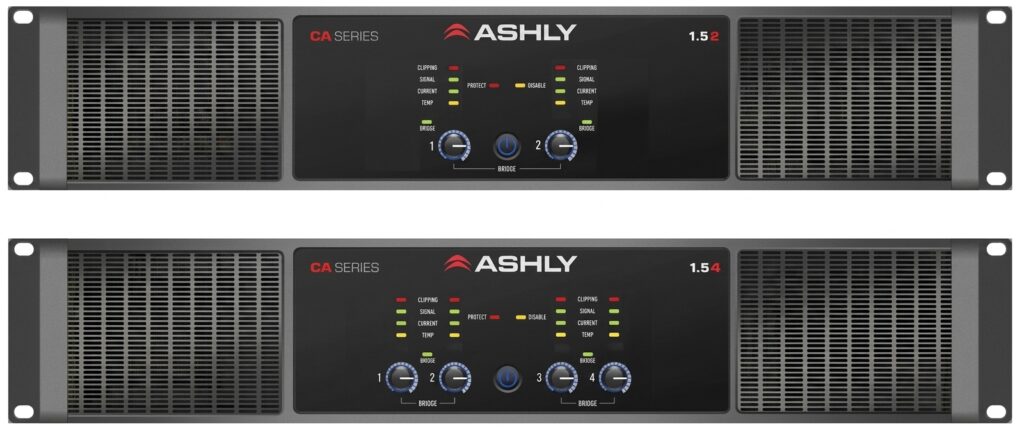
| CA1.52 | 2 | 1,500W | Two-zone, higher output needs |
| CA1.54 | 4 | 1,500W | Four-zone, subwoofer-heavy systems |
Choose the CA1.04 when you need four separate zones without pushing past 1,000 watts per channel. Step up to the CA1.54 only if your speaker loads genuinely demand the extra headroom.
Common Questions Buyers Ask About the CA1.04
Buyers often hesitate on a few recurring points before purchasing. Addressing them upfront saves back-and-forth with a dealer later.
- Does it need a dedicated circuit? Not usually, thanks to its low current draw at partial power, though full four-channel operation at max output benefits from a dedicated 20A line.
- Can it run 2-ohm loads? Yes, all four channels handle 2-ohm loads reliably, which most amps in this price range cannot claim.
- Is it rack-mountable? Yes, the 2RU metal chassis fits standard 19-inch racks with handles built into the front panel.
- Does it support both low-impedance and constant-voltage speakers? Yes, the same unit switches between standard 2/4/8-ohm loads and 70V/100V distributed systems.
Maintenance Tips to Extend Amplifier Life
A power amplifier installed correctly still needs basic upkeep to perform for years. Simple habits protect your investment without much added effort.
- Clean the intake vents every few months to keep SailFlow cooling working as designed
- Confirm rack ventilation allows free airflow around the chassis, even though the amp runs cooler than most
- Recheck Euroblock connector torque annually, since vibration from HVAC systems can loosen terminals over time
- Keep firmware and DIP switch settings documented for each install, especially in multi-amp racks
- Inspect the power cable and IEC connector for wear if the amp travels between venues
These checks take minutes but prevent most of the service calls installers see with amplifier racks.
Is the Ashly CA1.04 Worth Buying?
For four-zone installations that need reliable, efficient power without oversized wattage, the Ashly CA 1.04 4-channel power amplifier CA1.04 earns its place in the rack. It handles low-impedance speakers and constant-voltage systems from the same chassis, runs cool under sustained use, and fits standard 19-inch racks without extra hardware.
The tradeoff is straightforward: if your project needs more than 1,000 watts per channel, look at the CA1.54 instead. For everything else in the house-of-worship, education, and conference room space, this amplifier covers the job cleanly.
Compare your speaker impedance and zone count against the specification table above, then reach out to a certified Ashly dealer to confirm the CA1.04 fits your exact rack and load requirements.
Frequently Asked Questions
What is the power output of the Ashly CA1.04?
Short answer: The CA1.04 delivers up to 1,000 watts per channel at 2 or 4 ohms, and 500 watts per channel at 8 ohms.
In 70V or 100V constant-voltage mode, each of the four channels still reaches the full 1,000-watt rating. Bridging two channels together raises output to 2,000 watts at 8 ohms or 100V, which covers subwoofer duty or a combined high-power zone without adding a second amplifier.
How many channels does the Ashly CA1.04 have?
Short answer: Four independent channels, each with its own gain, HPF, and clip limiter controls.
Each channel operates separately, so you can run four different zones at different volumes and settings from a single chassis. This setup suits houses of worship and schools that need distinct control over a sanctuary, lobby, and overflow room simultaneously.
Is the Ashly CA1.04 good for churches and houses of worship?
Short answer: Yes, it’s one of the more common amplifier choices for mid-size worship spaces needing multiple zones.
The four-channel layout covers a main sanctuary along with foyer, nursery, and overflow speakers from one unit. Its 70V capability also supports distributed ceiling speakers in classrooms or fellowship halls without a separate amplifier for that zone.
What is D-MAX technology in the Ashly CA1.04?
Short answer: D-MAX is Ashly’s proprietary Class D switching design that improves efficiency and reduces heat compared to older amplifier technology.
Combined with Dynamic Power Factor Correction, D-MAX lets the amplifier draw less current from the wall while maintaining full output. This is why multiple CA1.04 units can share a single 20-amp circuit, something bulkier legacy amplifiers usually cannot do.
How much does the Ashly CA1.04 weigh, and what size rack space does it need?
Short answer: The amplifier weighs 21 pounds and fits a standard 2RU rack space at 19 inches wide.
Its compact 3.5-inch height and metal chassis with side handles make it manageable for a single installer to mount without extra lifting equipment. This is noticeably lighter than analog amplifiers with similar wattage ratings.
Can the Ashly CA1.04 run both 4-ohm speakers and 70V distributed systems?
- Short answer: Yes, the same amplifier switches between low-impedance loads and constant-voltage 70V or 100V output.
This flexibility means one CA1.04 can serve a standard speaker pair in a conference room and a distributed ceiling system in a hallway, without needing two different amplifier models on hand for the installation.
About This Guide
This guide was compiled using Ashly Audio’s published architect and engineering specifications, official CA Series documentation, and current professional audio dealer listings, cross-checked for accuracy before publication. It reflects specifications current as of 2026.
Sources referenced:
- Ashly Audio, CA-1.04 Architect & Engineering Specifications
- Ashly Audio, CA Series Operating Manual
- Ashly Audio, CA Series Data Sheet
- Full Compass Systems, Ashly CA 1.04 Product Listing
- AVGear, Ashly CA 1.04 Series Specifications
Ready to spec your next install? Match your zone count and speaker impedance to the table above, then talk to an authorized Ashly dealer to confirm the CA1.04 is the right fit for your system.