

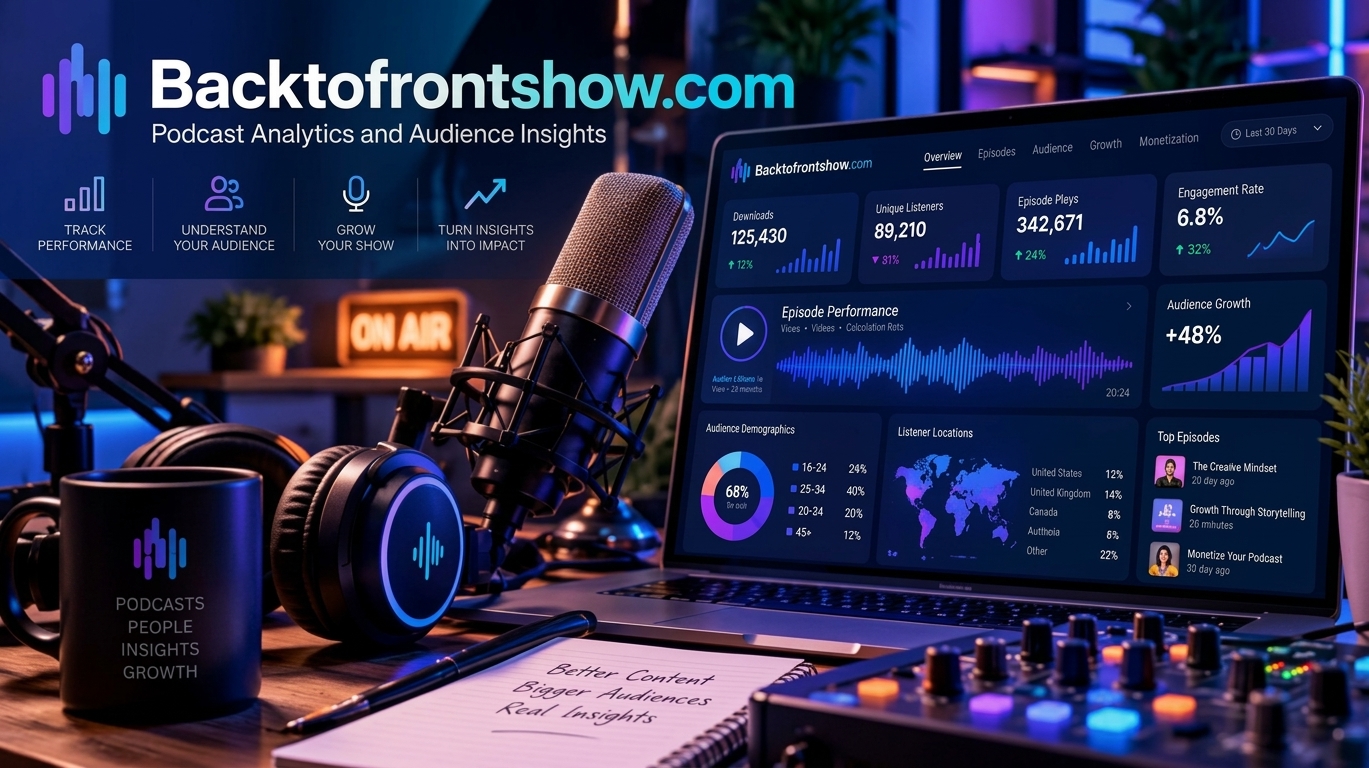
Backtofrontshow.com is a website that currently presents itself as a podcast analytics platform for podcast creators and media teams. Its homepage promotes tools for examining audience demographics, listening behavior, engagement, device usage, geographic information, and customized reports.
The main idea is to help users understand podcast performance beyond basic download totals. Instead of looking only at how many times an episode was downloaded, creators can benefit from examining available audience and engagement indicators.
However, advertised features should not automatically be treated as independently verified product capabilities. Users should confirm which data the platform collects, how it obtains that information, and which features are available under each subscription.
2. How Does BacktoFrontShow.com Work?
The website describes a workflow that connects podcast data, collects information, displays analytics through a dashboard, and produces customized reports.
The general process can be understood in four stages.
- Integration: Connect the podcast or relevant data source using the supported method.
- Data collection: Gather the information available through the integration.
- Analytics dashboard: Review the resulting measurements and trends.
- Custom reporting: Organize relevant findings into reports for planning or business decisions.
The exact setup requirements, supported podcast hosts, and integration methods should be confirmed with the provider before signing up.
For example, a creator who wants to compare episode performance should first determine whether the platform can access the relevant episode-level statistics. A dashboard cannot produce reliable insights from information it does not receive.
3. What Are the Key Features of BacktoFrontShow.com?
The website advertises several features intended to help users examine podcast audiences and performance.
| Feature | Advertised purpose | Potential benefit | What to verify |
|---|---|---|---|
| Audience demographics | Understand audience characteristics | Evaluate whether content reaches its intended audience | Available demographic fields and their sources |
| Listening behavior | Examine listener activity | Identify patterns in content consumption | Definitions of listening and retention metrics |
| Engagement analytics | Review audience interactions | Understand which episodes attract responses | Supported engagement sources |
| Device analytics | Examine device usage | Inform technical and distribution decisions | Available device categories and data coverage |
| Geographic analytics | Review audience locations | Plan regional promotion | Location accuracy and geographic detail |
| Custom reports | Organize selected metrics | Share findings with a team or sponsor | Export formats and customization options |
| Predictive analytics | Support forward-looking analysis | Explore possible audience trends | Methods, assumptions, and validation |
These features could be useful if they provide accurate information that is not already available through existing podcast analytics tools.
Before relying on any feature, request a demonstration showing real examples of the available data and how the platform calculates its measurements.
4. How Can Podcast Analytics Help Creators?
Podcast analytics helps creators make decisions based on audience behavior rather than assumptions.
For example, a creator may publish several episodes on different subjects but receive similar download totals for each one. Looking at additional information, when available, may reveal differences in engagement, listening patterns, or audience response.
This information can support decisions such as:
- Choosing subjects for future episodes.
- Identifying episodes that deserve additional promotion.
- Evaluating changes in publishing schedules.
- Comparing campaign results.
- Preparing reports for sponsors.
- Understanding whether a podcast reaches its intended audience.
The value depends on the quality of the underlying data and the decisions it supports.
Analytics should guide experimentation rather than replace editorial judgment. A single popular episode does not necessarily prove that its topic will succeed every time.
5. Understanding Audience Demographics
Audience demographics can help podcast creators understand who listens to their content, provided the platform has access to reliable and appropriately collected demographic information.
Useful information may include age ranges, geographic regions, or other audience characteristics, depending on the source and privacy limitations.
For example, a podcast about professional development might aim to reach working professionals. If reliable data indicates that its audience differs from the intended group, the creator can reconsider promotional channels, episode topics, or messaging.
However, not every podcast platform can identify an individual listener’s age, interests, or personal characteristics. Some services offer only aggregated or estimated information.
When evaluating BacktoFrontShow.com, ask:
- Which demographic categories are available?
- Are the results directly measured, inferred, or estimated?
- How are missing or incomplete records handled?
- Can users see the data source behind each metric?
These questions help separate meaningful audience intelligence from unsupported assumptions.
6. Can BacktoFrontShow.com Track Listening Behavior and Engagement?
The website advertises listening-behavior and engagement analytics. These categories can help creators examine how audiences interact with podcast content.
Depending on the platform and available integrations, useful podcast metrics may include episode downloads, listening duration, completion rates, repeat consumption, or audience interactions.
Not every provider can measure all these indicators across every listening service.
For example, download counts and actual listening time are different measurements. A downloaded episode does not necessarily mean that someone listened to the entire recording.
Creators should also distinguish between engagement on a podcast platform and engagement on social media. Likes, comments, shares, and other interactions may come from separate services and may not be accessible through a single integration.
Before using BacktoFrontShow.com for performance reporting, confirm the definitions of its metrics and whether its measurements can be compared consistently across platforms.
7. What Are Geographic and Device Analytics?
Geographic analytics examines the locations associated with available audience data. Device analytics looks at the devices or device categories used to access content.
These measurements can help creators understand distribution patterns and identify opportunities for improvement.
Consider a podcast that attracts listeners from several countries. Geographic information may help its team decide where to test advertising campaigns, arrange events, or publish localized promotional material.
Device information may help a production team understand whether its audience primarily accesses episodes through mobile devices, desktop computers, or other supported categories.
However, geographic results may be approximate, and device information depends on what the data source shares.
Do not assume that a platform can identify a listener’s exact location or device without limitations. Ask how these categories are determined and whether the information is aggregated.
8. How Do Custom Reports Help Podcast Teams?
Custom reporting turns individual measurements into information that teams can review and act on.
A podcast creator may need a short monthly report, while a media agency may need a more detailed comparison across several shows. A sponsor may want a summary of campaign performance, subject to the data the publisher can legitimately provide.
Useful reporting capabilities can include:
- Selecting relevant metrics.
- Comparing performance across episodes.
- Reviewing trends over a chosen period.
- Exporting results for presentations.
- Sharing reports with authorized team members.
- Separating campaign measurements from general audience statistics.
BacktoFrontShow.com advertises customized reporting, but buyers should verify the available export formats, reporting limits, scheduling options, and collaboration controls.
A well-designed report should make important findings easier to understand. It should not simply display more numbers without explaining what they mean.
9. How Much Does BacktoFrontShow.com Cost?
Pricing is an important consideration when choosing podcast analytics software, especially for independent creators and smaller production teams.
The public website has displayed three plan categories: Basic, Pro, and Enterprise. Its listed prices have included $1,200 per month for Basic and $3,600 per month for Pro, with Enterprise pricing available through direct contact. These figures should be checked against the current pricing page before making a purchasing decision.
| Plan | Price displayed on the website | Advertised positioning | What buyers should confirm |
|---|---|---|---|
| Basic | $1,200/month | Core podcast analytics and reporting | Current price, feature limits, and billing terms |
| Pro | $3,600/month | Additional audience and growth analysis | Included features, usage limits, and support |
| Enterprise | Contact provider | Additional analytics and integrations | Custom pricing, contract terms, and implementation costs |
Important: These are website-listed figures, not independently verified offers or a guarantee that the plans are currently available at those prices.
Before purchasing, request a written quote that explains:
- Monthly and annual billing options.
- Contract length and cancellation terms.
- Any onboarding or implementation charges.
- User and podcast limits.
- Available integrations.
- Support arrangements.
- Refund policies and renewal conditions.
At these displayed prices, buyers should carefully compare the service with alternatives and confirm that the additional capabilities justify the expense.
10. Who Should Consider BacktoFrontShow.com?
The platform’s advertised purpose may appeal to organizations that need more detailed podcast reporting.
Potential users include:
Independent podcasters: Creators who want a clearer picture of audience behavior and episode performance.
Podcast networks: Teams managing several shows that need consistent reporting and comparisons.
Digital marketing agencies: Agencies that evaluate podcast campaigns or prepare reports for clients.
Media companies: Organizations that use audience information to guide programming, promotion, and commercial planning.
Podcast advertising teams: Teams that need reliable measurements to evaluate campaigns and communicate results to sponsors.
Suitability depends on the actual features, data access, pricing, and support available.
For a small podcast with modest reporting needs, an existing hosting dashboard may provide enough information. A larger organization may benefit from more advanced analytics if the platform supplies verified data and fits its workflow.
11. What Are the Main Advantages and Limitations?
Evaluating both benefits and drawbacks helps buyers make a balanced decision.
| Area | Potential advantage | Possible limitation |
|---|---|---|
| Audience insights | More detail than basic download counts | Results depend on data availability |
| Reporting | Can organize information for teams | Export and customization options need confirmation |
| Engagement analysis | May reveal useful audience patterns | Metrics may differ between platforms |
| Geographic information | Can support regional planning | Location data may be approximate |
| Pricing structure | Published tiers provide an initial reference | High displayed prices may not suit smaller creators |
| Integrations | Could simplify reporting workflows | Supported services need verification |
| Predictive tools | May help explore future trends | Accuracy and methodology should be demonstrated |
The key question is not whether a platform advertises many features. It is whether those features solve real problems for the intended user.
A short demonstration using representative data can help buyers judge usability, accuracy, and practical value before making a commitment.
12. BacktoFrontShow.com vs. Other Podcast Analytics Tools
BacktoFrontShow.com operates in a category that includes podcast hosting dashboards, listening-platform analytics, and dedicated analytics services.
The best alternative depends on what a creator needs to measure.
| Tool category | Main purpose | Best suited for | Main consideration |
|---|---|---|---|
| Podcast hosting analytics | Track performance through a hosting provider | Independent creators and small teams | Available metrics depend on the host |
| Listening-platform analytics | Review activity within a particular service | Creators focused on a specific listening platform | Data may not cover every distribution channel |
| Social media analytics | Measure interactions with promotional content | Marketing and community teams | Social engagement does not equal podcast listening |
| Dedicated analytics platform | Combine or analyze multiple data sources where supported | Networks and data-focused teams | Integration quality, cost, and data consistency |
| BacktoFrontShow.com | Advertises audience, behavior, device, geographic, and reporting features | Potentially data-focused podcast teams | Verify capabilities and commercial terms directly |
A fair comparison should use the same criteria for each provider: available data, reporting accuracy, integration support, privacy controls, usability, and total cost.
Do not assume that a dedicated analytics product automatically offers more reliable information than tools supplied by a podcast host or listening platform.
13. Is BacktoFrontShow.com Safe and Trustworthy?
A professional-looking website does not, by itself, prove that a service is reliable, secure, or suitable for a business.
Before sharing business information or purchasing a subscription, review the website’s contact information, privacy policy, terms of service, data-handling practices, and cancellation conditions.
Pay particular attention to these questions:
- Who operates the service, and how can the operator be contacted?
- What information does the platform collect?
- Does it explain how audience data is processed?
- What security controls protect account information?
- Can customers export and delete their data?
- Are pricing and cancellation terms clearly documented?
- Can the provider demonstrate the advertised capabilities?
A third-party website may provide an automated trust assessment, but such a score is not a guarantee of business legitimacy or product quality.
The sensible approach is to verify important details directly, request written answers, and avoid committing to an expensive plan until the service meets your requirements.
14. How Should You Evaluate BacktoFrontShow.com Before Signing Up?
Use a structured evaluation process instead of relying on promotional descriptions alone.
Step 1: Identify your reporting needs
List the questions you want analytics to answer. Examples include which episodes perform best, where your audience is located, and how campaigns affect engagement.
Step 2: Confirm compatibility
Ask whether the service supports your podcast host, listening platforms, and existing reporting tools.
Step 3: Request a demonstration
Ask the provider to demonstrate the actual dashboard, data sources, metric definitions, and report exports.
Step 4: Review privacy and security
Read the privacy policy and ask how the platform protects, stores, and shares information.
Step 5: Compare total costs
Compare the quoted subscription with your existing tools and other suitable options. Include onboarding, contract commitments, and any additional charges.
Step 6: Set measurable goals
Define what success looks like before committing. You might aim to reduce reporting time, improve campaign measurement, or obtain a clearer view of episode performance.
Step 7: Review the results
If access is granted, test the platform with representative data and check whether the insights are accurate, useful, and worth the cost.
This process makes it easier to decide whether the product meets your needs rather than paying for features you may never use.
Frequently Asked Questions
1. What is backtofrontshow.com?
BacktoFrontShow.com currently presents itself as a podcast analytics platform. Its website advertises audience demographics, listening behavior, engagement metrics, device and geographic analytics, and customized reports.
2. Is BacktoFrontShow.com a podcast streaming website?
Its current homepage primarily promotes analytics software rather than a general podcast streaming service. The domain also contains historical podcast-related material, so check the specific page you are visiting.
3. How much does BacktoFrontShow.com cost?
The website has displayed Basic at $1,200 per month and Pro at $3,600 per month, with Enterprise pricing available on request. Confirm current prices, contract terms, and plan availability directly with the provider.
4. Who can benefit from BacktoFrontShow.com?
Podcast creators, networks, agencies, and media teams may find its advertised reporting features relevant. The platform’s suitability depends on data quality, available integrations, actual capabilities, and budget.
5. Does BacktoFrontShow.com provide accurate audience data?
Accuracy depends on the information sources, collection methods, metric definitions, and integrations. Request a demonstration and ask how the provider validates demographic estimates and engagement measurements before relying on the results.
6. Should I purchase a BacktoFrontShow.com subscription?
Compare the service’s verified features, security practices, current pricing, and contract terms with your needs and available alternatives. Request written details before making a financial commitment.
Conclusion: Make an Informed Decision About BacktoFrontShow.com
BacktoFrontShow.com presents an analytics-focused approach to podcast management, with advertised features covering audience demographics, listening behavior, engagement, geographic patterns, device usage, and customized reporting.
These capabilities may be relevant to creators and media teams that need more insight than basic download statistics provide. However, the practical value depends on the accuracy of the available data, integration support, pricing, and the provider’s ability to demonstrate its claims.
Before requesting access or purchasing a subscription, verify the current plans, review the privacy and contractual terms, and compare the service with your existing analytics tools.
The next step: Visit the official website, request a demonstration, and ask for a written breakdown of the features and costs. A careful evaluation will help you decide whether the platform offers enough measurable value for your podcast or media business.